
Laboratory Glassware Names and Uses: A Complete Guide with Pictures
Every piece of lab glass is shaped for one kind of job. Knowing laboratory glassware names and uses helps you pick the right item for the accuracy you need. It also stops common mistakes, such as measuring a solution in a beaker. This guide gives each item's name, its main use, and the job it is not made for.
Most items below are made from borosilicate glass 3.3, which handles heat and most chemicals well. You can see the related items in the laboratory glassware catalog.
Measuring glassware: names and uses
These items hold or deliver a known volume. They differ mainly in how accurate they are.
Beaker

Use: holding, mixing, dissolving and heating liquids. The wide mouth makes stirring and pouring easy. Not for: accurate measuring. Its marks are rough guides only.
Measuring cylinder

Use: measuring a liquid volume quickly, with better accuracy than a beaker. Not for: making standard solutions. Use a volumetric flask for that.
Volumetric flask
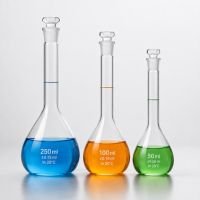
Use: making a solution to one exact volume and concentration, using the single calibration mark on its narrow neck. Not for: heating or storing solutions. Heat can change its volume.
Pipettes
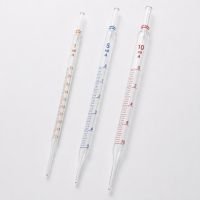
Use: moving a measured volume of liquid. A volumetric (bulb) pipette delivers one fixed volume. A graduated pipette delivers a chosen volume from its scale. Not for: mouth suction. Always use a pipette filler.
Burette
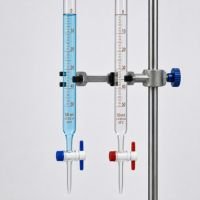
Use: adding a liquid drop by drop and reading the volume used, mainly in titration. A stopcock controls the flow. Not for: storing solutions or strong alkalis over long periods, which can make a glass stopcock stick.
Reaction and heating glassware
Test tube and boiling tube
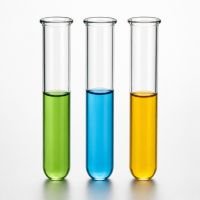
Use: small reactions, quick tests and heating small amounts. A boiling tube is wider and thicker for stronger heating. Not for: measuring volumes.
Conical flask
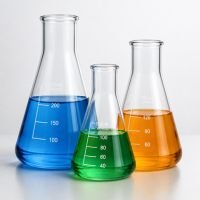
Use: mixing, swirling, titration and gentle heating. The narrow neck cuts splashing. Not for: vacuum work unless it is a heavy-wall filter flask.
Round-bottom and boiling flasks
Use: heating, reflux and distillation. The round shape spreads heat evenly and handles pressure change better. Not for: standing on a bench alone. It needs a ring, cork ring or clamp.
Separation and filtration glassware
Separating funnel
Use: splitting two liquids that do not mix. A stopcock lets you drain the lower layer. Not for: hot liquids. Release pressure often when shaking solvents.
Filter funnel
Use: gravity filtration with filter paper, or pouring into a narrow-necked container. Not for: vacuum filtration, which needs different apparatus. Use a Büchner funnel and filter flask for that.
Büchner funnel and filter flask
Use: fast vacuum filtration. The flat, perforated plate holds filter paper, and the heavy-wall side-arm flask connects to a vacuum. Not for: ordinary flasks under vacuum. Thin-walled flasks can implode.
Stillhead and adapters
Use: joining a flask to a condenser and a receiver in a distillation set-up. Many stillheads have a port for a thermometer. Not for: mixing joint sizes. Parts must share the same ground-glass size to seal.
Condenser
Use: cooling vapour back into liquid. A Liebig condenser suits simple distillation. Allihn (bulb) and coil condensers give more cooling surface for reflux. See the condensers range for common types.
Heating and culture glassware
Two more items complete the laboratory glassware names and uses that most school, college and hospital labs meet in routine practical work.
Crucible
Use: heating solids strongly, for example to find mass lost on ignition. Most are porcelain, silica or metal. Sintered-glass crucibles are a separate type, used to filter and weigh solids. Not for: placing straight onto a cold surface when hot. Use tongs and a pipe-clay triangle.
Petri dish
Use: growing and observing microbes on agar in biology labs. The loose lid lets air in but keeps most dust out. Not for: heating solutions. Sterilize glass dishes in an autoclave or oven as your lab's method says.
Storage and handling glassware
- Reagent bottles: store chemicals and prepared solutions. Choose amber glass for light-sensitive reagents. See the glass reagent bottle range.
- Watch glasses: cover beakers, hold small samples, and dry off small amounts of liquid.
- Desiccators: keep dried samples away from air moisture, often after oven drying.
- Dropping bottles: dispense a reagent a few drops at a time.
- Wash bottles: rinse glassware and wash solids off a filter.
Laboratory glassware names and uses at a glance
| Name | Main use | Accuracy |
|---|---|---|
| Beaker | Mixing and heating | Rough |
| Measuring cylinder | Quick volume checks | Moderate |
| Volumetric flask | Standard solutions | High |
| Volumetric pipette | Fixed-volume transfer | High |
| Burette | Titration | High |
| Conical flask | Swirling and titration | Rough |
| Round-bottom flask | Reflux and distillation | None |
| Separating funnel | Liquid-liquid extraction | None |
| Büchner funnel | Vacuum filtration | None |
| Condenser | Cooling vapour | None |
| Crucible | Strong heating of solids | None |
| Petri dish | Growing microbes | None |
Care tips by item type
Learning laboratory glassware names and uses also means learning how to care for each item. Good care keeps glass accurate and safe for longer.
- Volumetric items: do not dry flasks, pipettes or burettes in a hot oven. Heat can shift their calibration. Rinse them and let them air dry.
- Heated items: check beakers, flasks and tubes for chips, cracks and scratches before each use. Damaged glass can break when heated.
- Stopcocks and stoppers: clean ground-glass parts after use so they do not seize.
- Graduated items: store them apart from other glass so their marks stay clear.
Your lab's safety officer and the maker's instructions should set the final rules for cleaning, heating and disposal of broken glass.
Why the glass grade matters
Borosilicate glass 3.3 is the usual choice because it resists heat shock and most chemicals. ISO 3585 defines its properties. Cheaper soda-lime glass is fine for some storage jobs, but it cracks more easily when heated.
For volumetric items, check the accuracy class too. Class A has tighter limits for analysis. Class B suits most teaching. Our guide to choosing laboratory glassware covers these points in more depth. For how glass is classed by material, accuracy and joint type, see the guide to types of laboratory glassware.
Ordering the items you need
Once you know the laboratory glassware names and uses your lab needs, write each line with the item name, size, accuracy class and quantity. The 25 essential glassware items checklist can help you spot gaps. LabExports quotes on request by quantity, spec and destination, so send your item list for a quote.