
Physics Lab Equipment List: 15 Instruments and What Each One Does
This physics lab equipment list covers the 15 instruments found in almost every school and college physics lab. For each one, you will find what it does and which experiments use it. The list spans measurement, mechanics, sound, optics, and electricity, with a short note on extra items for advanced courses.
Use it to check an existing lab, to plan a new one, or to write a purchase list. If you only need the minimum set to open a lab, read our basic physics lab equipment starter guide instead.
Measuring instruments on the physics lab equipment list
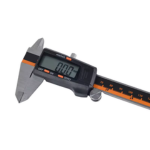
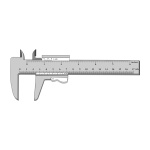
1. Vernier caliper
A vernier caliper measures outer size, inner size, and depth. A vernier scale slides along the main scale, so you can read between the main marks. Students use it to find the diameter of a sphere, a rod, or a tube.
2. Screw gauge (micrometer)
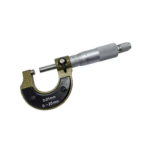
A screw gauge measures very small sizes, such as the diameter of a thin wire or the thickness of a sheet. A fine screw moves the spindle a set distance per turn, and a round scale shows fractions of a turn. It reads smaller sizes than a vernier caliper.
3. Metre scale
A metre scale is the basic tool for length. It appears in many mechanics and optics set-ups, for example to measure pendulum length or the distance from a lens to a screen.
4. Stopwatch
A stopwatch measures time intervals. Students use it to time pendulum swings or falling objects. Timing many swings and dividing reduces the effect of reaction time.
Mechanics and sound apparatus
5. Simple pendulum
A simple pendulum is a small bob on a light string. Students time its swings and use the result to find the acceleration due to gravity (g). It also shows that the period depends on length, not on the mass of the bob.
6. Spring balance
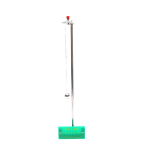
A spring balance measures force or weight. It works on Hooke's law: the spring stretches in proportion to the load, within its limit. It is used to show the link between force and extension.
7. Tuning fork
A tuning fork gives one fixed frequency when struck. It is used to study sound, vibration, and resonance. With a sonometer or resonance tube, students check the laws of vibrating strings and air columns.
Optics apparatus
8. Prism
A glass prism shows refraction, deviation, and dispersion. Dispersion is the separation of white light into its colours, because each colour bends by a slightly different amount.
9. Convex and concave lenses
Lenses are used for experiments on image formation. A convex lens makes light converge, and a concave lens makes it spread out. Students find focal length and magnification with them.
10. Mirrors (plane, concave, convex)
Mirrors are used to study reflection and the images formed by flat and curved surfaces. A concave mirror experiment to find focal length is common in school courses.
Electrical instruments
11. Galvanometer
A galvanometer detects and measures small currents. It is used as a null detector in bridge circuits. With a shunt or a series resistor, it can be converted into an ammeter or a voltmeter.
12. Ammeter
An ammeter measures current and is connected in series. It is used to verify Ohm's law and to study current in series and parallel circuits.
13. Voltmeter
A voltmeter measures the potential difference between two points and is connected in parallel. It is usually paired with an ammeter to find resistance.
14. Rheostat
A rheostat is a variable resistor. It lets students change the current in a circuit in steps, to take a set of readings for a graph.
15. Battery eliminator or DC power supply
A battery eliminator gives a steady low DC voltage from the mains, so the lab does not run through dry cells. A variable DC power supply does the same job with adjustable voltage and a current limit, which protects circuits and meters.
A quick-reference table
| Instrument | Measures or shows | Typical experiment |
|---|---|---|
| Vernier caliper | Length, diameter, depth | Volume of a cylinder |
| Screw gauge | Very small thickness | Diameter of a wire |
| Simple pendulum | Period of swing | Value of g |
| Spring balance | Force | Hooke's law |
| Tuning fork | Fixed frequency | Resonance tube |
| Prism | Refraction, dispersion | Angle of minimum deviation |
| Lenses and mirrors | Image formation | Focal length |
| Galvanometer | Small current | Meter bridge balance point |
| Ammeter and voltmeter | Current and voltage | Ohm's law |
| Rheostat | Variable resistance | Current control |
| DC power supply | Steady voltage | All circuit work |
Extra items for college and advanced courses
Once the core list is in place, higher-level labs usually add these instruments.
- Resistance boxes: set, known resistances for bridge and potentiometer work.
- Multimeters: one tool for voltage, current, and resistance.
- Transformer: for step-up and step-down experiments with AC.
- Spectrometer: measures the angle through which a prism or grating deviates light, so students can find refractive index or wavelength.
- Oscilloscope: shows voltage against time, for AC and waveforms.
- Bar magnet and electromagnet: for magnetic field and induction work.
- Optical bench: for accurate lens and mirror positions.
Modern physics items, such as spectrum tubes and discharge tubes, are covered in our high school physics lab guide.
Turning the physics lab equipment list into an order
For each line on your physics lab equipment list, write the quantity and the key spec. For measuring tools, give the range and least count. For meters, give analogue or digital and the ranges. For power supplies, give the output voltage and current and your mains voltage.
Buying for a public institution? Our lab tender support covers technical specification sheets, quotations, and bid paperwork.
Browse the instruments
LabExports manufactures these instruments in India and exports them by sea or air freight. See the physics lab equipment category, the electrical measuring instruments, and the optics range. Prices are quoted on request. Send your list through the quote request page.