
Physics Lab Experiments and the Apparatus Each One Needs
Most school and college courses are built around a set of classic physics lab experiments. Each one needs a specific set of apparatus, and a missing part can stop the whole practical. This guide lists common experiments by branch, with the apparatus each needs, so you can plan an order from the experiment outwards.
LabExports manufactures physics lab experiment equipment in India and exports it by sea or air freight. In our catalog it sits under physics lab experiment equipment, split into groups for mechanics, optics, electricity, heat, modern physics, and fluids. There is no separate sound group. Sonometers, resonance tubes, and ripple tanks are listed under electrostatic instruments. Spectrometers are listed with microscopes.
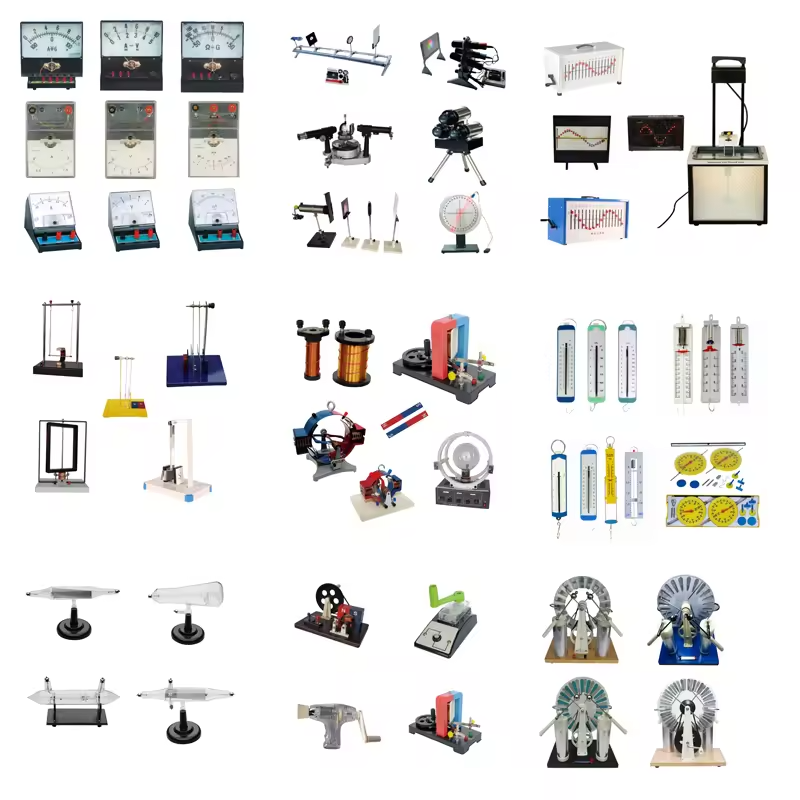
Why plan physics lab experiments first
Buying by item often leaves gaps. A school orders lenses but no holders, or a sonometer but no tuning forks. Planning by experiment fixes this. You list the practicals, then list what each one needs, down to the leads and masses.
It also makes the budget easier to defend. Every line on the order points to a practical in the syllabus.
Mechanics experiments
| Experiment | Apparatus |
|---|---|
| Find g with a simple pendulum | Pendulum bob and string, clamp stand, stopwatch, metre scale |
| Measure small sizes | Vernier calliper, screw gauge |
| Add forces and check balance | Force table, pulleys, slotted masses |
| Friction and forces on a slope | Inclined plane, friction block, spring balance |
| Hooke's law | Spring, pointer, scale, slotted masses |
Optics experiments
| Experiment | Apparatus |
|---|---|
| Focal length of a lens | Optical bench, convex lens, screen, light source |
| Focal length of a mirror | Concave mirror, holder, screen |
| Refraction through a prism | Glass prism, optical pins, drawing board |
| Wavelength with a grating | Spectrometer, diffraction grating, sodium lamp |
Electricity and magnetism experiments
| Experiment | Apparatus |
|---|---|
| Ohm's law | Ammeter, voltmeter, rheostat, resistor, DC supply, key |
| Unknown resistance | Meter bridge, galvanometer, resistance box, jockey |
| Compare EMFs of cells | Potentiometer, galvanometer, cells, key |
| Magnetic field of a coil | Tangent galvanometer or coil, compass, DC supply |
| Electromagnet strength | Electromagnet, DC supply, rheostat, iron pins or a spring balance |
Heat and thermodynamics experiments
| Experiment | Apparatus |
|---|---|
| Specific heat of a solid | Calorimeter, stirrer, thermometer, heater, balance |
| Heat conduction in metals | Heat conduction apparatus, thermometers |
| Cooling curve | Beaker, thermometer, stopwatch |
Sound and wave experiments
| Experiment | Apparatus |
|---|---|
| Laws of a vibrating string | Sonometer, tuning forks, masses |
| Speed of sound in air | Resonance tube, tuning forks, thermometer |
Physics lab experiments by course level
The same experiment can look very different at school and at university. At school, students may time ten swings of a pendulum with a stopwatch. At college, they may use a compound pendulum and plot a graph to find g more precisely. The core idea is the same, but the apparatus is not.
So tag each experiment on your list with the level it serves. School labs need sturdy, simple apparatus in larger numbers. College labs need fewer sets, but with finer scales and better meters. Mixing the two on one order is fine, as long as each line says which level it is for.
Why physics lab experiments fail in class
Most failed practicals come down to a few small causes. The spring is too stiff for the masses. The lens has the wrong focal length for the bench. The meter reads AC when the circuit is DC. The galvanometer has no centre zero, so a balance point is hard to see.
None of these is costly to fix before the order goes in. They are hard to fix after the goods arrive. That is why it pays to check the apparatus list against each experiment, line by line.
Turning the list into an order
Once you have the experiments, count how many groups will do each one at the same time. Multiply the apparatus by that number. Then add shared items once per lab, and spares for parts that wear out or break.
- Give the range and least count for every measuring tool.
- State AC or DC and the ranges for each meter.
- Give your mains voltage and plug type for power supplies and lamps.
- Name the practical list or syllabus, so the supplier can flag any gap.
What to expect from a physics experiments manufacturer
A manufacturer should give a spec for each item and a manual for each set-up. Ask for both. Ask how glass items are packed for export, and whether spares are wise for long transit. On delivery, check cartons against the packing list and try each experiment once before the first class.
Safety rules for each practical should come from your institution's safety officer and the manuals, especially for mains-powered and heated apparatus.
Browse and request a quote
Start with our physics lab experiment equipment, then add items from optical instruments, electricity instruments, heat apparatus, electrostatic instruments (which include sonometers and ripple tanks), and microscopes and spectrometers. Prices are quoted on request by quantity, spec, and destination. Send your experiment list through the quote request page.
For public tenders, our lab tender support covers spec sheets and bid paperwork. For experiments across chemistry and biology too, read our science lab experiments guide.