
Trinocular Microscope Buyer's Guide: Light Paths, Cameras and Specs
A trinocular microscope has two eyepieces, like a binocular microscope, plus a third vertical tube for a camera. A prism or beam splitter in the head sends light to the eyepieces, to the camera, or to both. This lets you view a specimen and record it at the same time. This guide explains how the head works, the main types, how to fit a camera, and what to check before you buy.
How a trinocular microscope head works
Light from the specimen passes up through the objective into the head. There, a prism directs it along one or more paths. Heads handle this in two main ways:
- Switched light path. A slider or knob sends all the light to the eyepieces (100:0) or all of it to the camera (0:100). You get full brightness on whichever path is in use, but not both at once.
- Split light path. The prism shares the light, for example 50:50 or 20:80 between eyepieces and camera. You can look and record at once. A 20:80 split, with most light going to the camera, suits photography in bright field.
Some heads offer three positions: all light to the eyepieces, a split, and all light to the camera. Check which options a model has, since this decides how you will work.
Types of trinocular microscope
- Compound trinocular microscope. For slides in biology, pathology, and teaching. A typical model has a 45° inclined head that turns through 360°, an Abbe condenser (NA 1.25) with an iris, and fine focus graduated to 0.002 mm.
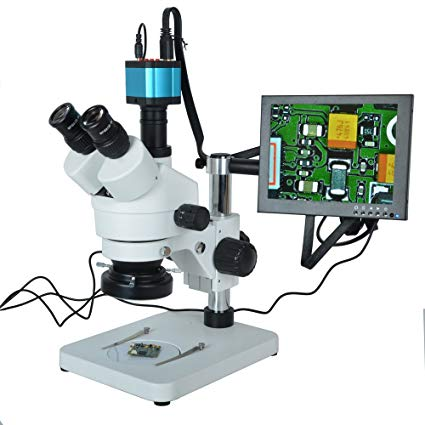
- Stereo zoom trinocular microscope. For solid objects such as insects, seeds, and circuit boards. It gives a 3D view at low magnification, with a long working distance.
- Trinocular research microscope. Better objectives and illumination for long sessions and publication-quality images.
- Inverted trinocular microscope. Objectives below the stage for live cells in flasks and dishes.
- Trinocular metallurgical microscope. Reflected light for polished metals. Our metallurgical microscope buyer's guide covers this type.
The laboratory microscopes category lists all of these, and the research microscopes range includes trinocular research models.
Fitting a camera
Most cameras attach to the third tube with a C-mount adapter. The adapter often has a reduction lens, such as 0.5x. This matches the image to the camera's small sensor so you do not lose the edges of the field. As a rough guide, a 1/2-inch sensor pairs with a 0.5x adapter, and a smaller sensor needs a stronger reduction. For live teaching on a screen, check the frame rate too, so the image does not lag as you move the slide.
Check three things before you choose a camera. First, the sensor size and resolution. Second, the output, such as USB to a PC or HDMI to a monitor. Third, whether the camera is parfocal with the eyepieces, so the image is sharp in both at once. Many trinocular tubes or C-mount adapters allow this adjustment, but not all economy models do, so check before you buy.
Key specs to compare
| Spec | What to check |
|---|---|
| Head | Incline angle, rotation, light-path options |
| Objectives | Achromatic or plan; 4x to 100x oil for compound models |
| Eyepieces | WF10x, field number, eye guards |
| Illumination | LED or halogen, with brightness control |
| Stage | Mechanical stage, travel range, slide holder |
| Camera port | C-mount, adapter lens, parfocal adjustment |
| Software | Capture, measurement, file formats |
Uses of a trinocular microscope
- Clinical labs. Staff can capture images and video and share them with colleagues for a second opinion.
- Teaching. A teacher can show the whole class what is on the slide through a monitor or projector, and check what a student is looking at.
- Research and industry. Images support reports, presentations, and quality records.
- Students. Learners can take photos and video and compare them with their textbooks.
The biggest benefit is a lasting record. Many prepared specimens change or fade after a while. With a trinocular microscope you can capture them at their best and view them again later.
Care
Keep the camera tube capped when no camera is fitted, so dust cannot reach the prism. Store the microscope under a cover in a dry place. Clean lenses with lens paper, following the maker's manual. Spare eyepieces, objectives, and lamps are listed under microscope accessories.
What to include in a trinocular microscope request
- Type (compound, stereo zoom, research, inverted, or metallurgical).
- Light-path split you need.
- Objectives, eyepieces, and illumination.
- Camera, adapter, monitor, and software, if needed.
- Quantity, mains voltage, delivery country, and any tender reference.
LabExports makes and exports microscopes and other biology lab equipment from India, along with physics, chemistry, and engineering lab equipment. Prices are quoted on request. For institutional bids, see the lab tender support page, or request a trinocular microscope quote.