Biology Lab Equipment
Amoeba Model
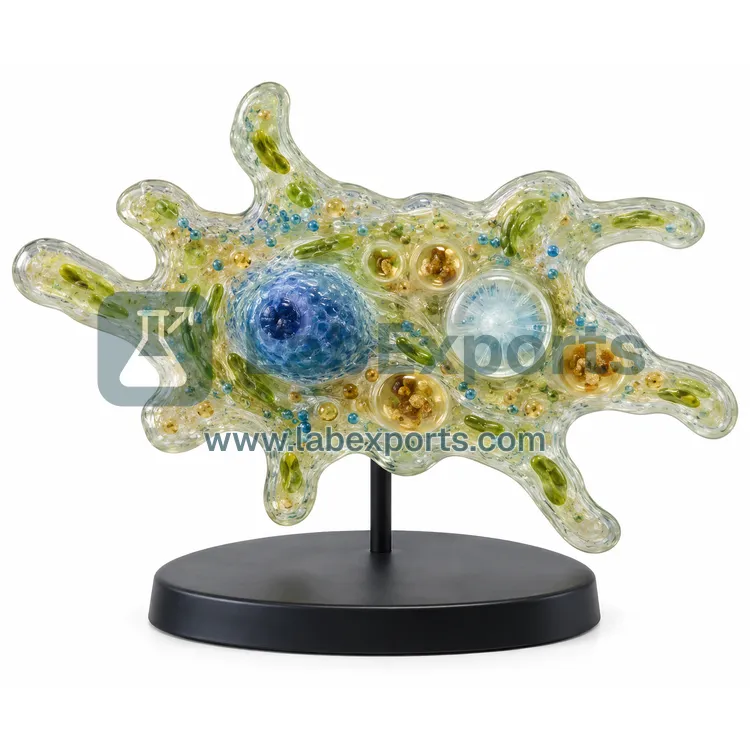
Amoeba Model: s are used in classrooms to teach students about single-celled organisms; they also help illustrate basic cell structure and function concepts.
- Price
- On request, by quantity and destination
- Tender documents
- Specification sheet and quotation on request
- Category
- Biology Lab Equipment
Product details
Amoeba models are used in classrooms to teach students about single-celled organisms. They also help illustrate basic cell structure and function concepts. Furthermore, amoeba models serve as excellent hands-on experiments in biology, chemistry, and physics - as they allow for hands-on experiments of cell evolution! For this reason, they make excellent educational tools.
Amoeba models by LabExports serve as valuable educational and research tools, providing a range of benefits:
For Students:
Visualization of Cellular Structures: Amoeba models provide a physical means for viewing the various organelles and structures within a unicellular organism; therefore, they facilitate our understanding of cell biology concepts.
Understanding Amoeboid Movement: The dynamic pseudopodia (false feet) observed on these models allow students to comprehend better how amoebae move and get their food.
Engaging Learning Experience: Models are interactive, hence promoting active learning, which leads to greater interest in microbiology.
Safe and Ethical Alternative: Models do not require live specimens, thus addressing the ethical issues and dangers related to handling microorganisms.
For Researchers
Cellular processes investigations: Amoeba models can be used by researchers to analyze intricate processes like phagocytosis, division and intracellular transport.
Formulation of hypothesis and experiment designs: These amoeba models can contribute to making hypothesis statements or developing experiments aimed at understanding amoeba behavior or cellular functions better.
Communication of results: The use of models as visual tools in presentations and publications enables colleagues and other members of the scientific society to visualize the research results clearly.
Overall, amoeba models provide a valuable bridge between the microscopic world and human understanding, facilitating learning, research, and scientific communication.